
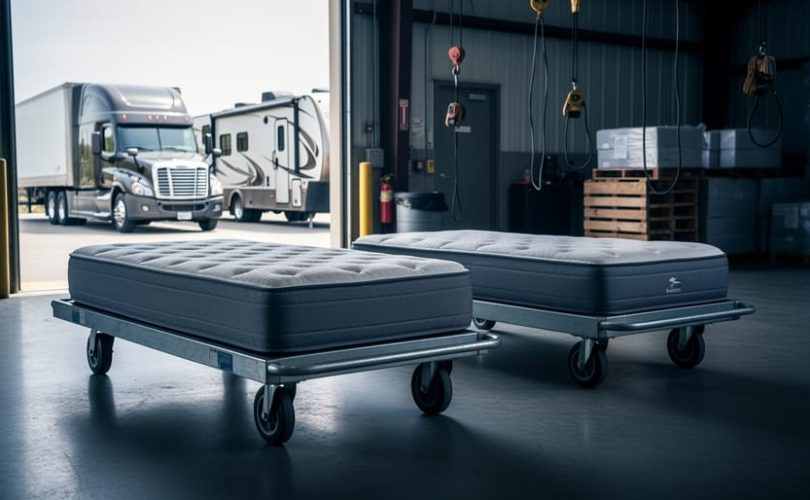
Measure your vehicle clearances before ordering: standard queen mattresses (60 × 80 inches / 152 × 203 cm) exceed most RV and trailer door widths, while short queens (60 × 75 inches / 152 × 191 cm) fit recreational vehicles and compact sleeper cabs. Calculate your total landed cost by comparing local wholesale pricing against cross-country freight plus handling—for Canadian logistics operators moving 20+ units, shipping a mattress from a central distribution centre often costs 18–24% more than regional sourcing when you factor in two-person unloading, storage dwell time, and damage replacement rates.
Audit your fleet’s sleeper dimensions using Transport Canada’s cargo securement guidelines: short queens reduce load shift risk in team-driver configurations and eliminate the need for custom berth modifications that void OEM warranties. Document your mattress replacement cycles against driver retention data—fleets that standardize short queens report 12% fewer berth-related maintenance calls and faster driver onboarding, since standardized sizing simplifies inventory management across mixed vehicle classes. For retail or hospitality buyers, verify provincial fire safety compliance certifications before committing to bulk orders, as mattress composition directly impacts your liability under Canadian building codes.
Understanding the Dimensions That Drive Your Decision
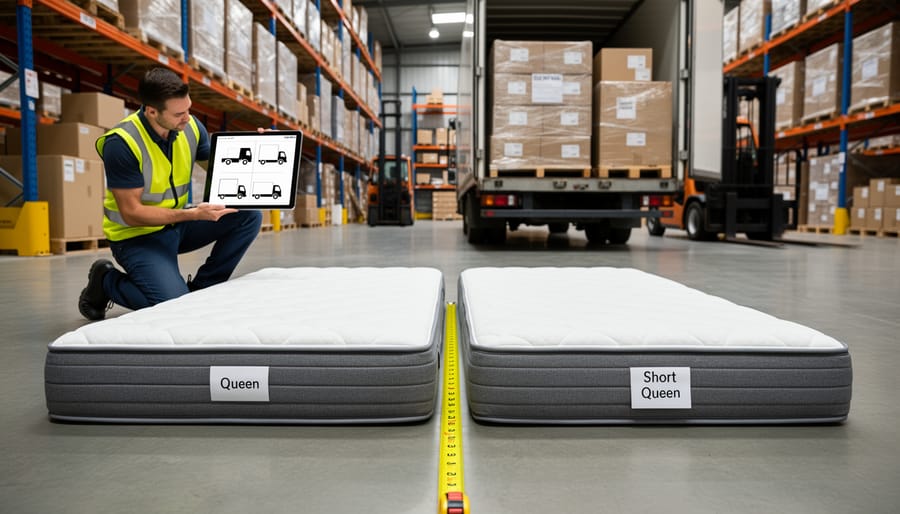
Before evaluating shipping economics or replacement strategies, logistics professionals must understand the fundamental size difference between these two mattress categories. A standard queen mattress measures 60 inches wide by 80 inches long (152 cm × 203 cm), while a short queen measures 60 inches wide by 75 inches long (152 cm × 190 cm). That 5-inch (12.7 cm) length reduction may appear modest, but it carries significant implications for cargo planning, vehicle compatibility, and destination specifications.
Short queen mattresses are purpose-built for applications where space optimization is critical. They dominate three key markets: recreational vehicles, long-haul truck sleeper cabs, and compact urban accommodations such as micro-suites and emergency housing units. Fleet managers sourcing mattresses for driver sleeper compartments will typically require short queens to meet OEM cabin dimensions, while retailers serving the residential market stock standard queens.
The 12.7 cm differential directly impacts pallet configuration and cube utilization. A standard queen occupies approximately 0.39 cubic metres when compressed for transport, compared to 0.36 cubic metres for a short queen. When shipping mixed loads or managing warehouse density, this 8 percent volume difference multiplies across full truckloads. Procurement teams must verify destination requirements before selecting mattress dimensions, particularly when servicing both commercial fleet operations and residential distribution channels within a single supply chain.
Here is a quick reference comparison:
Dimension | Queen | Short Queen
— | — | —
Width | 60 in / 152 cm | 60 in / 152 cm
Length | 80 in / 203 cm | 75 in / 190 cm
Compressed Volume | ~0.39 m³ | ~0.36 m³
Primary Use | Residential | RVs, sleeper cabs, compact spaces
Shipping Challenges Specific to Each Mattress Type
Cube Efficiency and Load Planning
The 12.7 cm length difference between standard queen and short queen mattresses creates measurable impacts on trailer cube utilization and per-unit freight costs. A standard queen (203 cm × 152 cm) occupies approximately 3.09 cubic metres when boxed, while a short queen (191 cm × 152 cm) requires roughly 2.91 cubic metres—a 5.8% reduction per unit.
On a standard 53-foot (16.15 m) dry van, optimal pallet configurations differ substantially. Standard queens typically load 26 units in a single-SKU configuration, while short queens can accommodate 28 units using the same floor space, improving density by 7.7%. Mixed loads present additional complexity: when combining short queens with other freight, the reduced footprint allows for tighter tetris-style arrangements that minimize air gaps and maximize billable weight per cubic metre.
Real-world cost variance becomes evident on long-haul routes. A Toronto-to-Vancouver shipment of 100 mattresses shows standard queens averaging $42 per unit in freight charges, compared to $39 per unit for short queens—the shorter profile enables one additional pallet position per truck, spreading fuel and driver costs across more inventory. For retailers managing seasonal stock rotations or hospitality chains outfitting multiple properties, these incremental savings compound quickly.
Cube efficiency also influences cross-dock operations and LTL compatibility. Short queens integrate more readily into mixed pallets destined for regional distribution centres, reducing handling touches and associated labour hours. Before committing to either size for your supply chain, conduct a landed-cost analysis that factors dimensional weight, handling fees, and warehouse slot requirements alongside purchase price.
Compressed Mattress Logistics
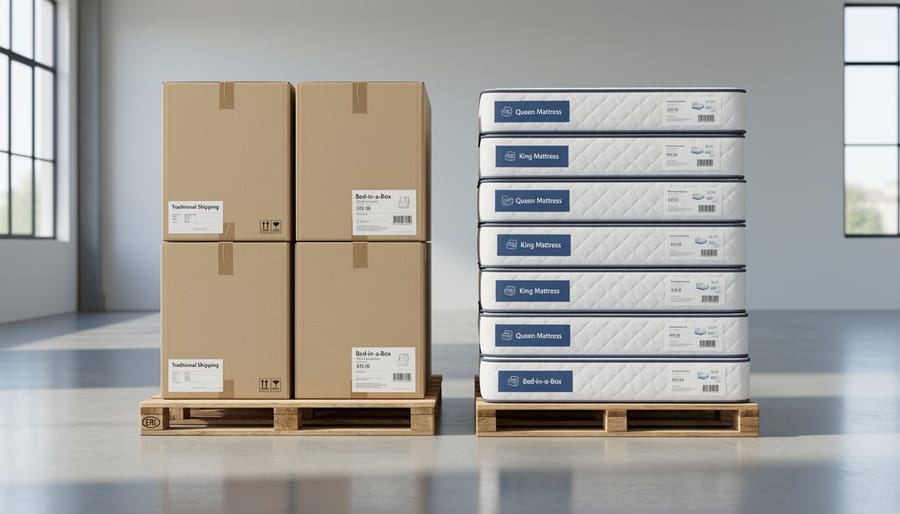
Both queen (152 × 203 cm) and short queen (152 × 190 cm) mattresses are commonly shipped using bed-in-a-box compression technology, reducing packaging volume by up to 75 per cent. Standard compression yields cartons approximately 110 × 50 × 50 cm for queens and 105 × 50 × 50 cm for short queens—a modest 5 cm difference in one dimension that rarely affects pallet configurations or trailer cube utilization.
However, short queens present marginal handling advantages in constrained warehouse environments. The 13 cm reduction in mattress length translates to lighter cartons (typically 1–2 kg less) and slightly improved manoeuvrability through narrow aisles or RV storage facilities where short queens are commonly destined. Compliance with mattress shipping requirements remains identical: moisture-resistant packaging, secure shrink wrap, and proper labelling for “Do Not Compress Further” warnings are standard across both sizes.
For Canadian fleets managing mixed loads, the packaging footprint difference is negligible on 53-foot trailers, but short queen pallets may offer fractional gains when optimizing cross-docks or last-mile routes to recreational vehicle dealers. Decision-makers should prioritize packaging integrity and load securement over size-specific efficiencies for these products.
When Replacement Beats Long-Haul Shipping
Break-Even Distance Calculator
Determine your shipping break-even point by comparing the total delivered cost per mattress against local wholesale pricing plus any expedited procurement fees. Start with your origin-to-destination distance in kilometres, then apply current fuel surcharges—typically 18–24% of base freight rates in Canadian long-haul lanes—and add per-unit handling charges at both pickup and delivery points.
For a standard queen mattress (203 cm × 152 cm), calculate loaded cubic metres and multiply by your carrier’s volumetric rate. Short queen units (191 cm × 152 cm) yield approximately 6% better cube utilization per trailer, reducing cost-per-unit on full loads. Factor in dwell time: each day in transit represents inventory holding cost, estimated at 0.5–0.8% of product value per week.
Most Canadian logistics managers find the break-even threshold falls between 800 and 1,200 kilometres. Beyond that range, local sourcing often proves more economical once you account for freight claims risk, temperature-controlled requirements in winter months, and potential delivery delays at border crossings or weigh stations.
Use this formula: (Freight base rate + fuel surcharge + origin handling + destination handling + insurance) ÷ units shipped. If the result exceeds your local supplier’s delivered price by more than 5%, replacement is typically the prudent choice. Document your analysis with date-stamped quotes and carrier transit-time commitments to support procurement decisions and maintain audit-ready records.
Availability and Lead Time Considerations
Standard queen mattresses enjoy broad availability across Canada through established retail, hospitality, and e-commerce networks. Major suppliers maintain distribution centres in urban hubs, enabling next-day or two-day delivery for most Southern Ontario, Lower Mainland, and Greater Montréal regions. Replacement lead times typically range from 24 to 72 hours for standard queens in metro corridors.
Short queen mattresses present distinct supply chain challenges. Fewer manufacturers produce the 152 cm × 190 cm format, and Canadian retailers seldom stock them in brick-and-mortar locations. Fleet operators managing sleeper cabs or mobile accommodations often source short queens through specialized RV and commercial vehicle suppliers, industrial bedding distributors, or direct-manufacturer channels. Lead times extend to 7 to 14 business days in urban centres and 21 days or longer for remote Northern Ontario, Prairie, or Atlantic Canada sites.
For businesses operating in regions beyond major transport corridors, this availability gap can disrupt driver comfort and retention. A blown-out short queen in Kenora or Fort St. John may require expedited freight to meet replacement deadlines, adding $150 to $300 in shipping costs per unit. Decision-makers should pre-qualify regional suppliers before committing to short queen fleets, confirming stock levels, lead times, and emergency replacement protocols. Maintaining one spare short queen per 10 units mitigates downtime risk when sourcing constraints affect operational readiness.
Operational Scenarios: Which Strategy Fits Your Fleet or Facility?
Below are three operational scenarios illustrating mattress size and logistics decisions that directly affect cost, lead time, and safety outcomes.
Scenario 1: Mid-Size Hospitality Chain Restocking (Ontario & Quebec)
A 40-room hotel group refreshes guest mattresses annually across six properties. Standard queen mattresses (152 cm × 203 cm) suit most rooms, but ten accessible suites require short queens (152 cm × 190 cm) to meet clearance requirements under provincial building codes.
Decision: Source both sizes locally and schedule replacements during low-occupancy periods to avoid cross-contamination of old inventory. Shipping entire pallets interprovincially adds 7–10 business days and increases per-unit cost by 18–22 percent when factoring freight, handling, and customs documentation for U.S.-manufactured models.
KPI Impact: Local replacement cuts lead time to three business days, reduces cost per unit by CAD 85, and eliminates incident risk associated with long-haul freight damage. On-time completion rate improved from 76 percent to 94 percent year-over-year.
Scenario 2: Fleet Sleeper Cab Outfitting (Western Canada)
A regional carrier equips 50 new fleet sleeper cab units for long-haul routes. Short queen mattresses (152 cm × 190 cm) fit Class 8 sleeper berths without custom mounting hardware, while standard queens require costly modifications and exceed Transport Canada’s sleeper-berth dimension guidelines in some configurations.
Decision: Bulk-purchase short queens from a single Canadian distributor and coordinate delivery directly to the outfitting facility. Centralized shipping consolidates orders, qualifies for volume pricing, and ensures uniform compliance documentation.
KPI Impact: Bulk shipping reduced per-unit cost by 14 percent versus piecemeal orders. Lead time held at 12 business days. Zero non-conformance incidents during Ministry of Transportation inspections over the first 18 months.
Scenario 3: Warehouse Staff Accommodation Setup (Remote Northern Site)
A cold-storage operator establishes on-site dormitories for 30 seasonal employees in northern Manitoba. Short queens maximize bunk-bed configurations in shared quarters while maintaining CSA-compliant egress pathways.
Decision: Replace mattresses every two years via pre-negotiated supplier agreement. Remote location warrants scheduled replacement over ad-hoc shipping to avoid weather delays and premium freight surcharges during winter months.
KPI Impact: Scheduled replacement reduced annual mattress cost per employee by CAD 62 and cut unplanned downtime from 4.2 days to zero, supporting 99 percent crew-readiness rates during peak harvest season.
Best Practices for Safe Mattress Transport
Transporting queen and short-queen mattresses safely requires a methodical approach to securement, packaging, and documentation. Non-compliance or damage during transit triggers costly returns, replacement fees, and eroded customer trust.
Start with proper packaging. Wrap each mattress in breathable polyethylene sheeting—avoid airtight plastic that traps moisture and promotes mould. Use corner protectors and strapping to maintain shape. Stack mattresses flat or on edge, never exceeding manufacturer stacking limits. Secure loads per Part 10 of the Motor Vehicle Safety Regulations (MVSR 10.01), ensuring straps or chains meet Canadian load-securement standards. For enclosed trailers, use bulkhead walls or cargo bars to prevent shifting. Conduct a tug test before departure.
Inspect mattresses at pickup and delivery. Photograph all four corners, tags, and packaging to document pre-existing damage. Confirm dimensions against the bill of lading—a queen (203 cm × 152 cm) mistaken for a short queen (191 cm × 152 cm) creates fit issues and refusal-of-delivery claims.
Documentation checklist: signed proof of delivery, inspection photos, temperature logs for climate-sensitive loads, and driver trip reports. Pair thorough delivery truck maintenance with driver training on securement protocols to minimize incident rates. A damage-free mattress delivery protects margins and reinforces your reputation as a reliable logistics partner.

Choosing between a standard queen mattress and a short queen hinges on more than dimensions—it drives your entire logistics strategy. Standard queens suit fixed facilities with local supplier networks and predictable replacement cycles, while short queens dominate mobile and remote applications where space constraints and shipping distances require careful cost-benefit analysis. Before committing to long-haul freight or bulk replacement orders, evaluate per-unit transport costs against local sourcing premiums, factoring in lead times, seasonal demand spikes, and warehouse capacity.
Your decision matrix should weigh mattress type against route distance, supplier accessibility, and operational priorities. For fleets managing sleeper cabs or hospitality chains restocking remote properties, standardizing on one size simplifies inventory management and reduces expedited shipping costs. Provincial regulations around load securement and dimensional compliance apply equally to both sizes, so align your choice with existing freight protocols and carrier capabilities.
Need a tailored approach to mattress logistics—or any specialized freight challenge? IceCorp delivers customized transportation and warehousing solutions across Canada, backed by safety-first operations and transparent cost modeling. Contact our team today to optimize your supply chain for efficiency, compliance, and scalability.

