

Verify your vape and CBD logistics partner holds current Transport Canada Dangerous Goods certification before signing any distribution contract. Under federal law, many vaping products containing nicotine, THC, or lithium batteries qualify as dangerous goods requiring specialized handling, documentation, and vehicle placarding—non-compliance triggers fines up to $50,000 per incident and shipment delays that disrupt retail inventory.
Audit your current shipping documentation against the Transportation of Dangerous Goods Regulations, Schedule 1. Nicotine solutions exceeding 10 mg/mL, lithium-ion batteries over 100 watt-hours, and aerosol products fall under Class 3, Class 9, or Class 2.1 classifications. Each shipment requires proper classification numbers, emergency response information, and trained handlers with valid TDG certificates renewed every three years.
Implement a three-tier compliance checklist: confirm your carrier maintains commercial general liability insurance covering dangerous goods transport (minimum $5 million), conducts annual vehicle inspections documented with Ministry of Transportation approval stamps, and employs drivers holding valid TDG training certificates. Request copies of these documents quarterly and store them for seven years to satisfy federal audit requirements.
Map provincial retail regulations alongside federal transport rules. While Transport Canada governs movement between facilities, provincial authorities control age verification at delivery, packaging standards, and retail licensing. Your logistics partner must coordinate both layers to prevent shipment rejections, especially when crossing provincial boundaries where nicotine concentration limits and flavour restrictions vary significantly.
Understanding M&M Vapes Federal Regulations in Canada
In Canada, “M&M Vapes federal” refers to the federal government’s regulatory oversight of vape products—from manufacturing and labeling through to distribution and cross-border movement. The Tobacco and Vaping Products Act (TVPA), enforced by Health Canada, sets national standards for vaping product safety, packaging, nicotine concentration limits, and advertising restrictions. Under the TVPA, all vape devices and e-liquids sold in Canada must comply with federal requirements, including child-resistant packaging, bilingual labeling, and nicotine content ceilings (20 mg/mL for most products).
Health Canada’s role extends beyond product approval. The agency conducts market surveillance, issues recalls for non-compliant items, and works closely with the Canada Border Services Agency (CBSA) to prevent illegal or mislabeled vape goods from entering the country. For B2B logistics providers and retailers, this means every shipment must be traceable, properly documented, and verifiable against federal standards before it moves through the supply chain.
Federal rules intersect with provincial and territorial legislation in important ways. While Health Canada sets the baseline for product standards, provinces and territories enforce age-gating (18+ or 19+, depending on jurisdiction), retail licensing, and point-of-sale restrictions. For example, Ontario prohibits vape sales in pharmacies, while Quebec bans flavoured e-liquids except in specialty vape shops. Logistics providers must ensure shipments comply with both federal product standards and the destination province’s retail and age-verification requirements.
Transporters also face federal hazardous goods regulations when handling vape devices containing lithium-ion batteries. Transport Canada classifies these as Class 9 dangerous goods, triggering packaging, labeling, and driver training obligations under the Transportation of Dangerous Goods Act. Non-compliance can result in fines, shipment delays, and liability exposure—underscoring the need for logistics partners who understand the layered regulatory environment governing vape distribution across Canada.

Critical Shipping and Transport Compliance Requirements
Dangerous Goods and Lithium Battery Rules
Vaping devices fall under Transport Canada’s Transportation of Dangerous Goods Act because they contain lithium-ion batteries—classified as Class 9 dangerous goods. Understanding these rules is essential for any business shipping vape products across provincial or international borders.
Under the TDG requirements for batteries, vape devices must meet specific packaging standards. Batteries installed in equipment (like pre-filled vape pens) require less stringent handling than loose cells, but all packages must prevent short circuits and damage during transit. This means using non-conductive inner packaging, securing terminals, and applying the appropriate dangerous goods marks and labels.
Driver training is mandatory. Anyone transporting dangerous goods by road must complete TDG certification and carry proof of training. Fleet operators must ensure drivers understand the unique risks of transporting batteries, including thermal runaway hazards and proper load segregation.
Every shipment requires Emergency Response Information (ERI)—a document or placard providing first responders with critical data about the product, hazards, and recommended actions in case of fire, spill, or collision. Carriers must have ERI accessible in the vehicle at all times.
Non-compliance carries significant penalties: fines up to 50,000 dollars, shipment delays, and liability exposure if an incident occurs. Partnering with a logistics provider experienced in TDG compliance reduces risk, streamlines documentation, and ensures your vape products reach retailers safely and legally.
Age Verification and Delivery Protocols
Compliant last-mile delivery of vape products requires robust age-verification protocols at every handoff. Drivers must scan government-issued photo identification—driver’s licence, passport, or provincial ID card—to confirm the recipient is 19 years of age or older (18 in Alberta and Quebec). Digital scanning equipment captures the verification timestamp, ID type, and expiry date, creating an auditable trail for provincial enforcement reviews.
Signature capture is mandatory. Drivers present a handheld device or paper manifest, obtain the recipient’s signature, and cross-reference the name against the ID. If the recipient appears underage, lacks valid identification, or displays signs of intoxication, the driver must refuse the delivery and return the package to the distribution centre. No exceptions.
Recordkeeping protocols align with federal and provincial retention requirements. Each delivery generates a digital record containing:
• Verified recipient name and date of birth
• ID scan image or document number
• Delivery timestamp and GPS coordinates
• Driver signature and recipient signature
These records remain accessible for a minimum of three years to satisfy audits by Health Canada, provincial inspectors, or municipal enforcement teams. Automated reporting flags anomalies—multiple rejections at one address, missing signatures, or ID-scan failures—so supervisors can investigate and retrain drivers promptly. This systematic approach protects carriers, shippers, and retailers from non-compliance penalties while reinforcing public-health safeguards.

Risk Mitigation Strategies for Logistics Providers
Reducing compliance risk in vape and cannabis-derived product logistics requires a multi-layered approach. Fleet managers and third-party logistics providers (3PLs) can implement the following practical strategies to safeguard operations and maintain federal compliance.
Driver training programs form the foundation of compliant transport. Develop mandatory modules covering the Tobacco and Vaping Products Act (TVPA), packaging and labelling requirements, age-verification protocols, and provincial transport variations. Schedule refresher sessions quarterly and require drivers to complete competency assessments. Document all training completion dates and scores in personnel files—Transport Canada auditors will verify these records during inspections.
Digital documentation systems eliminate paper-trail gaps. Deploy fleet management software that captures proof of delivery with digital signatures, timestamps, and GPS coordinates. Configure systems to automatically log product descriptions, batch numbers, and recipient credentials. Real-time audit trails demonstrate due diligence if shipments face scrutiny. Ensure your platform meets Canada’s Personal Information Protection and Electronic Documents Act (PIPEDA) requirements when handling customer data.
Real-time tracking capabilities provide visibility and accountability. Equip vehicles with telematics that monitor route adherence, unauthorized stops, and temperature conditions for climate-sensitive vape products. Set automated alerts for deviations that could indicate diversion or tampering. This data proves chain-of-custody integrity during compliance reviews.
Insurance considerations must reflect specialized risk. Standard commercial auto policies may exclude coverage for federally regulated products like vapes. Work with brokers experienced in controlled-goods transport to secure appropriate liability limits, cargo coverage, and errors-and-omissions protection. Review policy exclusions annually as regulations evolve.
Regular compliance audits catch issues before regulators do. Conduct internal monthly spot-checks of delivery documentation, driver certifications, and vehicle inspection reports. Engage third-party auditors semi-annually to benchmark against industry standards and identify blind spots. Track two critical KPIs:
Compliance audit pass rate: Target 98% or higher on internal monthly audits and 95%+ on external reviews.
Incident rate: Measure regulatory warnings, fines, or shipment rejections per 10,000 deliveries. Best-in-class providers maintain rates below 0.5%.
Establish a corrective-action protocol for any non-conformance. Document root causes, implement fixes within 48 hours, and retrain affected personnel immediately. This proactive stance demonstrates good-faith compliance efforts should federal enforcement escalate.
Partnering with logistics providers who embed these practices into daily operations transfers risk while ensuring your supply chain meets federal standards.
Common Compliance Pitfalls and How to Avoid Them
Even experienced carriers and shippers stumble over vape product compliance. Understanding where others falter—and how to sidestep these traps—protects your operations, your team, and your bottom line.
Inadequate driver training on Transportation of Dangerous Goods (TDG) ranks among the most common and costly oversights. Vaping products containing lithium batteries or nicotine solutions qualify as dangerous goods under Transport Canada regulations, yet many drivers receive only generic hazmat briefing. Without product-specific instruction on Class 9 miscellaneous goods handling, emergency response, and proper placarding, your fleet risks roadside violations, shipment delays, and liability exposure. The fix: implement quarterly refresher courses that cover vape-specific TDG scenarios, document all training with signed records, and verify that every driver holds a current TDG certificate before assigning loads.
Bilingual labelling failures create immediate compliance headaches. Federal law mandates that shipping documents, emergency response information, and package labels appear in both English and French. Single-language paperwork triggers fines during roadside inspections and can halt cross-border shipments at customs. Solution: audit your label templates and shipping forms now, source bilingual placards from approved suppliers, and require your warehouse team to verify language compliance during pre-shipment checks.
| Compliance Pitfall | Business Impact | Solution |
|---|---|---|
| Inadequate TDG driver training | Roadside fines, shipment delays, liability claims | Quarterly product-specific courses, signed records, certificate verification |
| Missing bilingual labels | Inspection failures, border delays, federal penalties | Audit templates, source compliant placards, pre-shipment language checks |
| Poor cross-border documentation | CBSA holds, missed delivery windows, customer churn | Customs broker partnership, standardized export checklists, HS code validation |
| Outdated procedures after reg changes | Non-compliance gaps, insurance disputes, reputational damage | Quarterly Transport Canada monitoring, procedure update protocol, team notifications |
Cross-border documentation errors plague shippers moving vape products into or out of Canada. Incomplete Canadian Border Services Agency (CBSA) forms, incorrect Harmonized System (HS) codes, or missing product safety certifications cause shipments to sit in customs limbo. Partner with a licensed customs broker who specializes in regulated goods, create standardized export checklists for your shipping team, and validate HS codes with CBSA before the first cross-border movement.
Regulatory change blindness leaves carriers scrambling. Transport Canada, Health Canada, and provincial authorities update vape product rules with little advance notice. Companies that rely on annual compliance reviews miss critical amendments and operate outside the law until an incident forces a costly correction. Establish a quarterly monitoring routine: assign one team member to review Transport Canada bulletins, subscribe to federal regulatory alerts, and update your standard operating procedures within 30 days of any change. Communicate updates immediately to drivers, warehouse staff, and dispatch through toolbox talks and written notices.
Partnering with a Compliance-First Logistics Provider
Navigating the complex regulatory landscape of vape and CBD logistics demands specialized expertise, infrastructure, and a proven compliance track record. For many B2B decision-makers, outsourcing to a dedicated third-party logistics (3PL) provider offers a practical path to mitigate risk, reduce overhead, and ensure every shipment meets federal and provincial standards.
A compliance-first logistics partner brings more than trucks and drivers. Look for carriers with documented training programs covering TVPA requirements, dangerous goods classifications, and age-verification protocols. Drivers should hold current certifications and receive regular refreshers on handling restricted products, recognizing packaging violations, and documenting chain-of-custody at every handoff.
Technology platforms matter. Your 3PL should offer real-time shipment tracking, automated compliance reporting, and integration with your inventory systems. Transparent dashboards that display on-time delivery percentages, incident rates, and cost-per-stop metrics enable data-driven decisions and accountability.
Audit history provides insight into operational discipline. Request evidence of recent Transport Canada inspections, provincial compliance audits, and any corrective actions taken. A partner with clean audit results and a proactive approach to regulatory updates demonstrates the systems and culture needed to protect your brand.
Certifications signal credibility. Verify that your logistics provider maintains current dangerous goods certifications, holds appropriate liability insurance for controlled substances, and participates in industry associations that promote best practices in vape and CBD transport.
Finally, seek partners who view compliance as a shared responsibility. The right 3PL will collaborate on risk assessments, help refine your packaging and labelling protocols, and provide consultative guidance as regulations evolve. This partnership approach transforms logistics from a transactional service into a strategic advantage that safeguards your supply chain and strengthens customer trust.
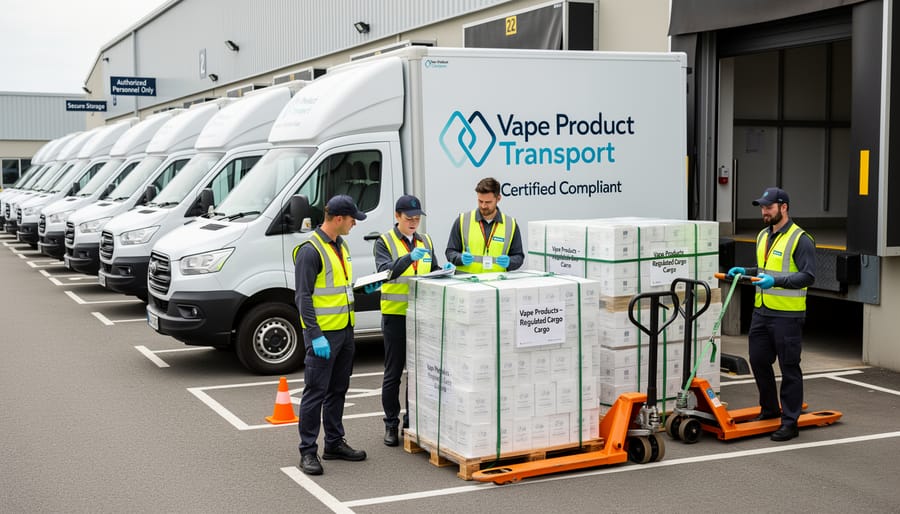
Navigating M&M Vapes federal compliance demands more than good intentions—it requires a proactive approach anchored in current Transport Canada regulations, robust driver training, and meticulous documentation. For Canadian retailers and distributors handling vape and CBD products, partnering with a logistics provider that understands these nuances isn’t optional; it’s a strategic safeguard against regulatory penalties, shipment delays, and reputational risk.
IceCorp’s dedicated fleet solutions are built on a safety-first foundation, combining deep compliance expertise with specialized handling protocols for regulated goods. Our drivers receive ongoing training on federal packaging, labelling, and hazard classification rules, ensuring every delivery meets legal standards from dock to doorstep. Transparent KPI tracking—including on-time delivery rates and incident metrics—gives you real-time visibility and confidence in your supply chain.
Ready to move your vape or CBD products with certainty? Explore how IceCorp’s compliance-driven approach and dedicated transportation resources can protect your brand and streamline your logistics. Contact us today to discuss your specific needs.