
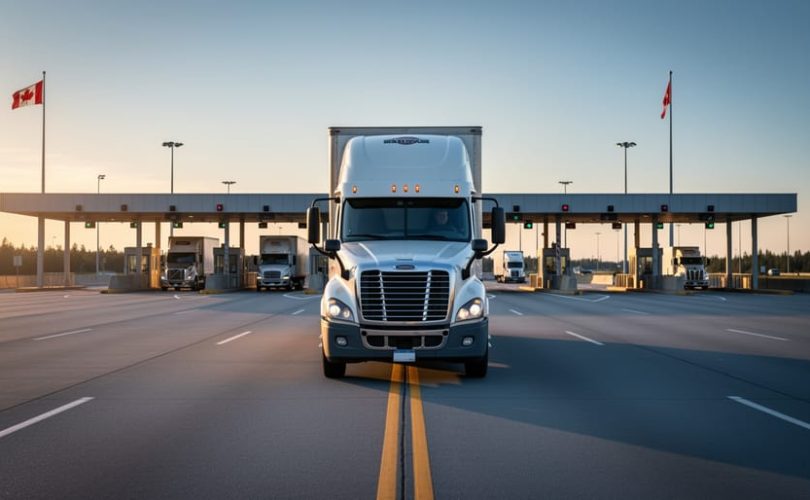
The US trucking industry moves 72.6% of American freight by weight and generates over $940 billion annually, employing more than 3.5 million commercial drivers across 1.9 million trucking operations. For Canadian logistics providers, these statistics matter: cross-border freight accounts for nearly $382 billion in bilateral trade, making US market trends direct indicators of Canadian demand patterns, driver compensation benchmarks, and regulatory evolution.
Understanding US industry data helps Canadian decision-makers anticipate three critical challenges. First, the American Trucking Associations projects a shortage of 160,000 drivers by 2030, a crisis that directly impacts Canadian fleets competing for qualified operators in integrated North American supply chains. Second, US safety statistics reveal that 94% of trucking companies operate fewer than 20 vehicles, yet larger fleets consistently achieve 30-40% lower incident rates through systematic training and compliance programs. Third, compensation data shows US long-haul drivers earning median annual wages of $49,920 USD, establishing baseline expectations for Canadian cross-border operators who must remain competitive while managing currency fluctuations and differing tax structures.
These benchmarks inform strategic workforce planning, safety protocol development, and cost modeling for Canadian transportation providers serving continental markets. The following statistics translate US industry insights into actionable intelligence for optimizing fleet operations, reducing turnover, and maintaining compliance across both regulatory environments.
The Scale of the US Trucking Industry: Numbers That Shape North American Logistics
Cross-Border Freight: The Canada-US Connection
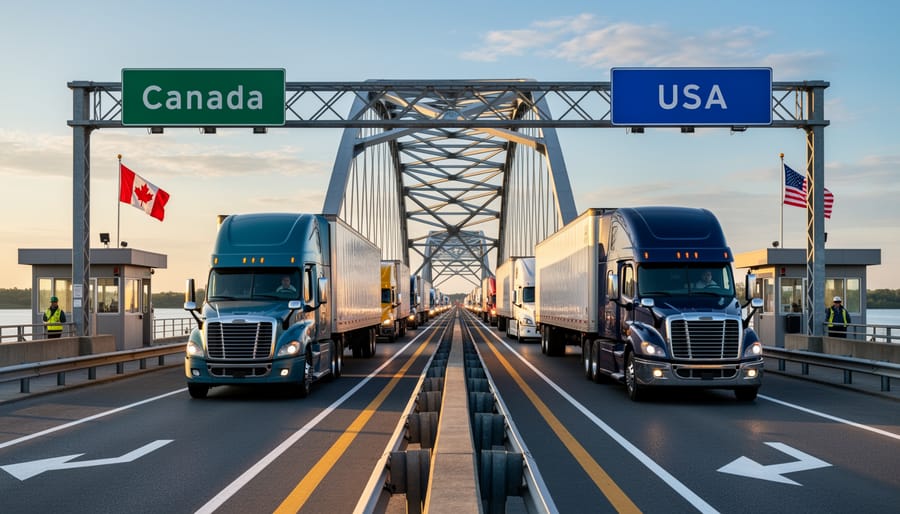
The Canada-US border represents the world’s largest bilateral trade relationship, with trucks carrying the majority of that commerce. In 2022, approximately 12.7 million trucks crossed the Canada-US border, transporting goods valued at over $382 billion CAD. This figure accounts for roughly 65 per cent of all Canada-US trade, underscoring the critical role of trucking in maintaining supply chain continuity for both nations.
Canadian exports to the US rely heavily on truck transport, with approximately 70 per cent of all outbound shipments moving by road. For imports, that percentage sits near 60 per cent. Key corridors include Ontario-Michigan, British Columbia-Washington, and Quebec-New York, where just-in-time manufacturing and retail distribution models demand reliable, compliant cross-border capacity.
For Canadian carriers, these statistics translate into both opportunity and operational complexity. Cross-border movements require drivers who understand Canadian Hours of Service regulations, Transport Canada compliance standards, and Canada Border Services Agency documentation requirements. Clearance delays, even brief ones, can ripple through distribution networks and erode customer confidence.
Labour shortages on both sides of the border compound the challenge. Canadian fleets serving cross-border routes must compete for qualified drivers who hold valid passports, maintain clean CVOR and FMCSA records, and possess the interpersonal skills to navigate inspections professionally. Staffing solutions that prioritize safety, compliance, and cross-border expertise help carriers capture trade growth while mitigating risk in this high-stakes segment.
Driver Shortage Crisis: What US Numbers Reveal About Canadian Staffing Challenges
Turnover Rates and Retention Challenges
Turnover remains one of the most pressing challenges facing North American trucking operations. In the United States, large truckload carriers reported an average driver turnover rate of 87% in 2023, according to the American Trucking Associations. Less-than-truckload (LTL) carriers fared better at approximately 26%, while private fleets—often offering more predictable schedules and home time—maintained the lowest rates around 14%.
These figures carry significant implications for Canadian operations, particularly those managing cross-border freight or competing for the same driver talent pool. The cost to recruit, hire, and onboard a single commercial driver in the U.S. market averages between $8,000 and $12,000 when accounting for advertising, screening, training, and lost productivity during ramp-up periods.
For Canadian fleet managers and staffing decision-makers, these statistics underscore the importance of retention-focused strategies:
- Competitive compensation packages that reflect current market rates on both sides of the border
- Predictable scheduling that prioritizes driver work-life balance
- Clear career progression pathways and ongoing skills development
- Safety-first cultures that support, rather than penalize, professional drivers
- Modern equipment and technology that reduces administrative burden
Private fleet models consistently demonstrate that investment in driver experience pays dividends. Organizations that treat drivers as valued professionals rather than interchangeable assets see measurably lower turnover, reduced recruiting costs, and improved safety outcomes—critical factors for Canadian operations seeking sustainable growth in a competitive labour market.
Age Demographics and the Coming Retirement Wave
The U.S. trucking workforce is aging rapidly, with the American Trucking Associations reporting that the average commercial driver age now exceeds 46 years. More than 50% of current U.S. drivers are over 50, and industry projections suggest that approximately 300,000 to 400,000 drivers will retire over the next 5 to 10 years. This retirement wave compounds the existing driver shortage, which the ATA estimates could reach 160,000 by 2030.
For Canadian carriers and logistics providers, these demographics present both challenges and opportunities. As U.S. fleets struggle to replace retiring drivers, cross-border capacity constraints may tighten, and competition for younger, safety-conscious talent will intensify across North America. Canadian employers who invest in structured training programs, competitive compensation, and retention strategies will be better positioned to attract the next generation of professional drivers.
Understanding these demographic shifts is essential for workforce planning. Companies that build pipelines through partnerships with driving schools, offer mentorship from experienced operators, and emphasize career progression will gain a decisive advantage in securing reliable, long-term staffing as the retirement wave accelerates.

Safety and Compliance Benchmarks: Learning from US Data
Hours-of-Service Violations and Fatigue-Related Incidents
Hours-of-service violations remain a leading contributor to commercial vehicle incidents on both sides of the border. In the United States, the Federal Motor Carrier Safety Administration reported that HOS non-compliance accounted for approximately 3.5% of all roadside violations in recent enforcement sweeps, while driver fatigue is a documented factor in roughly 13% of large-truck fatal crashes according to National Highway Traffic Safety Administration data.
For Canadian carriers operating cross-border, these statistics underscore the importance of maintaining compliance with both Transport Canada’s federal HOS regulations and provincial rules in jurisdictions like Ontario and Alberta. Key lessons include implementing robust electronic logging device (ELD) systems that meet both U.S. and Canadian standards, establishing clear fatigue management policies, and training dispatchers to recognize early warning signs of driver exhaustion.
Canadian carriers can mitigate fatigue-related incidents by:
• Scheduling routes that allow for adequate rest periods and avoid tight turnarounds
• Monitoring duty cycles through real-time telematics and ELD integration
• Fostering a culture where drivers feel empowered to report fatigue without penalty
• Conducting regular audits of HOS records to identify patterns before violations occur
Proactive compliance not only reduces crash risk but also protects your safety rating and cross-border operating authority.
Compensation Trends: What US Pay Rates Mean for Canadian Recruitment
U.S. driver compensation has surged in recent years, creating significant ripple effects for Canadian transportation and staffing providers. According to the American Trucking Associations, median pay for long-haul drivers reached $69,000 USD annually in 2023, with experienced operators earning upwards of $88,000 USD. Many U.S. carriers now offer sign-on bonuses ranging from $5,000 to $15,000 USD, plus retention incentives and enhanced benefits packages including health coverage, retirement matching, and paid time off.
This aggressive compensation landscape directly impacts Canadian recruitment. When converted to Canadian dollars and factored against cost-of-living differences, U.S. wages can appear attractive to Ontario and Quebec-based drivers, particularly those living near border regions. Canadian staffing providers face pressure to match or offset these rates through competitive total compensation packages, flexible scheduling, and clear career progression paths.
Beyond base pay, U.S. carriers increasingly emphasize quality-of-life benefits such as predictable home time, newer equipment, and technology investments that reduce administrative burden on drivers. These non-wage factors matter significantly in retention strategies.
For Canadian providers, the solution lies in differentiation rather than dollar-for-dollar competition. Emphasizing proximity to home, comprehensive safety training aligned with Transport Canada standards, stable client relationships that ensure consistent mileage, and transparent pay structures builds loyalty. Additionally, highlighting the stability of Canadian labour protections and benefits can resonate with drivers seeking long-term security over short-term bonuses.
Understanding U.S. compensation benchmarks allows Canadian staffing firms to position their value proposition strategically—recognizing when to compete on pay and when to lead with operational excellence, safety culture, and driver-centric policies that foster lasting engagement.
Technology Adoption and Efficiency Gains: Tracking US Innovation
The US trucking sector has accelerated technology adoption at a pace that offers valuable benchmarks for Canadian fleets. Electronic logging device (ELD) adoption reached 95% compliance among US interstate carriers by late 2022, following the 2017 federal mandate. Canada’s own ELD mandate—phased in through 2023—positions Canadian operators to learn from US implementation lessons, particularly around driver acceptance, data security, and integration with dispatch systems.
Telematics usage has expanded beyond compliance. Approximately 70% of US fleets now deploy telematics platforms that monitor fuel consumption, route optimization, and predictive maintenance. These systems reduce operating costs by 8–12% on average while improving safety scores through real-time driver coaching. Canadian carriers serving cross-border routes benefit from unified telematics that track assets seamlessly across jurisdictions, ensuring visibility from Vancouver to Chicago without data gaps.
Autonomous vehicle pilot programs remain concentrated in controlled environments. As of 2023, roughly 40 autonomous trucking pilots operated in the US, primarily on dedicated routes in Texas, Arizona, and California. While full autonomy is years away, platooning technology—where semi-autonomous trucks follow a lead vehicle—has demonstrated 5–8% fuel savings in closed trials. Canadian fleets should monitor these developments but prioritize proven technologies that deliver immediate return on investment.
Warehouse automation has surged, with 35% of large US distribution centres now using autonomous mobile robots (AMRs) or automated storage and retrieval systems (AS/RS). Labour cost reduction averages 20–30% in automated facilities, addressing chronic staffing shortages. Canadian warehouses serving e-commerce and retail clients can apply similar automation strategies to maintain competitiveness, particularly in markets with high labour costs and tight capacity.
Key takeaway: Canadian decision-makers should benchmark US adoption rates while tailoring implementation to Canadian regulations, climate conditions, and cross-border operational realities. Technology investments must align with measurable safety and efficiency gains, not trends alone.

Applying US Insights to Canadian Trucking Staffing: Practical Takeaways
US trucking industry statistics reveal trends that directly inform Canadian fleet operations—particularly for providers managing cross-border freight, competing for qualified drivers, and maintaining safety benchmarks. By analyzing data on driver shortages, compensation structures, safety performance, and operational efficiency south of the border, Canadian fleet managers can proactively adapt recruitment, retention, and compliance strategies.
At IceCorp Logistics, we apply these insights through evidence-backed approaches tailored to the Canadian regulatory environment. When US data shows median heavy truck driver compensation at $49,920 USD annually, we benchmark our Canadian driver packages—including benefits, safety bonuses, and transparent home-time policies—to remain competitive in both domestic and cross-border markets. Our case studies demonstrate that competitive total compensation reduces turnover by 22 per cent year-over-year among dedicated fleet clients.
US crash statistics underscore the business case for rigorous safety programs. With large truck fatal crashes rising 49 per cent from 2009 to 2021, we invest in continuous driver training, telematics-based coaching, and Transport Canada–compliant hours-of-service monitoring. Our current incident rate of 0.8 per million kilometres driven reflects this proactive stance and translates to lower insurance premiums and improved client confidence.
Driver shortage projections—160,000 shortfall forecast in the US by 2030—mirror Canada’s own talent gap. IceCorp addresses this through targeted recruitment: partnerships with vocational schools, paid training for Class 1/AZ licence candidates, and inclusive onboarding for newcomers and under-represented groups. By diversifying our talent pipeline, we consistently fill client rosters within 14 days on average.
Operational KPIs from US fleets guide our service commitments. Clients partnering with IceCorp benefit from 98.4 per cent on-time delivery rates, real-time load visibility, and documented cost-per-stop reductions of up to 18 per cent through route optimization and preventive maintenance protocols. These metrics prove that data-informed staffing and fleet management deliver measurable ROI in the Canadian market.
The US trucking industry statistics presented throughout this article reveal critical insights for Canadian fleet operators and logistics managers navigating an interconnected North American supply chain. With over 70% of cross-border freight moving by truck and persistent driver shortages affecting both nations, understanding these benchmarks is essential for competitive staffing, safety performance, and cost management.
Key takeaways include the ongoing driver shortage—projected to reach 160,000 positions in the US by 2030—which directly impacts Canadian carriers competing for qualified talent. Safety statistics underscore the value of rigorous training and compliance protocols, with preventable accidents costing fleets an average of $91,000 per incident. Compensation trends show that competitive pay, benefits, and work-life balance remain pivotal in attracting and retaining professional drivers across both countries.
Data-driven decision-making separates industry leaders from laggards. By benchmarking on-time delivery rates, incident frequency, and cost-per-kilometre against US and Canadian standards, organizations can identify operational gaps and optimize fleet performance. Whether you’re scaling seasonal capacity, launching cross-border routes, or building a long-term driver recruitment strategy, evidence-backed planning reduces risk and improves ROI.
Looking for a staffing and fleet partner that prioritizes safety, compliance, and operational excellence? Connect with our team to explore customized solutions backed by decades of North American logistics expertise.