
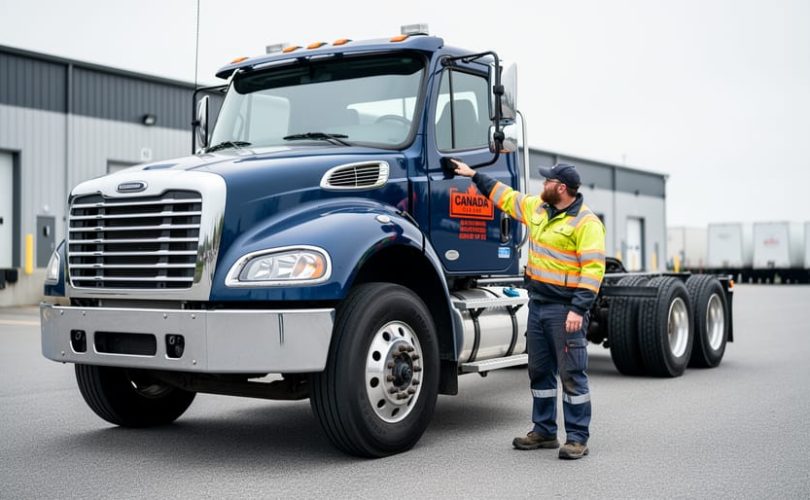
A Class B pre-trip inspection verifies that your single-unit commercial vehicle meets Transport Canada and provincial safety standards before you turn the key. The practical test requires you to demonstrate a systematic check of all required equipment, from air brakes and fluid levels to lights, tires, and cargo securement, while explaining each component’s purpose and condition to your examiner.
Passing this hands-on assessment is mandatory for Class B licensing across Canada, and the inspection sequence you learn will become your daily safety routine as a professional driver. While National Safety Code Standard 13 sets the federal baseline, provinces differ in specific forms, defect thresholds, and documentation requirements. Ontario requires a circle check following a prescribed order; British Columbia emphasizes brake system checks and adjustment limits; Alberta mandates detailed cargo securement inspection for every load.
Mastering the pre-trip isn’t about memorization. It’s about building a repeatable system that catches defects before they cause breakdowns, collisions, or roadside violations. The same discipline that earns your licence also protects your career and the public you share the road with. Integrating this procedure into a comprehensive fleet training program reduces incident rates and keeps commercial vehicles compliant year-round.
This guide walks you through the preparation, execution, and provincial compliance context you need to pass your Class B pre-trip inspection test on the first attempt.
What You Need to Prepare for Your Class B Pre-Trip Test
Walking into your Class B pre-trip inspection test with the right gear and documentation keeps your focus where it belongs: demonstrating competent, systematic vehicle inspection skills. Provincial testing centres expect candidates to arrive prepared with specific materials, and missing even one item can delay or derail your exam.
Most licensing authorities require you to bring or have access to a standardized inspection form that aligns with NSC Standard 13 and provincial commercial vehicle safety standards. Your training provider or testing facility typically supplies the form template, but confirm the format beforehand, some provinces accept digital checklists while others mandate paper copies. You’ll also need government-issued identification, your learner’s permit or existing driver’s licence, and any training completion certificates your examiner requests.
Beyond paperwork, practical equipment is essential. Pack these items before test day:
- A high-beam flashlight or inspection light for checking under-vehicle components, wheel wells, and dark recesses
- Work gloves to protect your hands when physically inspecting tires, coupling devices, and potentially dirty or sharp equipment
- A reflective safety vest meeting CSA Z96 standards, required whenever you conduct roadside inspections
- A pen or pencil and clipboard for recording defects clearly on your inspection form
- The vehicle operator’s manual (if your testing authority permits reference materials during the exam)
Check with your test administrator whether you’ll inspect a vehicle you provide or one supplied by the facility. If you’re bringing your own Class B vehicle, ensure it’s roadworthy and representative of the equipment you’ll operate professionally, examiners assess both your inspection process and your ability to identify real defects.
Personal Protective Equipment isn’t optional. CCOHS workplace safety guidelines and provincial occupational health regulations mandate appropriate PPE during vehicle inspections, and examiners evaluate your adherence to these standards as part of demonstrating professional competence. Steel-toed boots, while not always required for the test itself, are standard practice in commercial driving and show you understand industry safety culture.
Safety Warnings and Stop Conditions

Before you step under or around any Class B commercial vehicle, recognize that pre-trip inspections carry real physical hazards. A systematic approach to safety protects you from injury and ensures your inspection is legally valid under Canadian workplace safety regulations.
When to Stop or Abort Your Inspection
Certain conditions make it unsafe or impossible to complete a thorough pre-trip inspection. Stop immediately if you encounter unstable vehicle positioning (vehicle on a slope without chocks, wobbly jacks, or unsecured parking brake), active fluid leaks pooling under the vehicle (fuel, coolant, or hydraulic fluids), or unsecured cargo shifting inside or protruding from the vehicle. Severe weather also warrants postponement: freezing rain coating inspection surfaces, whiteout snow conditions limiting visibility, or ice accumulation that prevents safe access to components all justify delaying your inspection until conditions improve or you can move to a sheltered inspection bay. A comprehensive winter maintenance plan should address inspection protocols during harsh Canadian winters.
Required Personal Protective Equipment
CCOHS workplace safety standards require high-visibility vest or clothing, steel-toed safety boots, and work gloves during exterior inspections. In winter months, insulated gloves that maintain dexterity for checking components are essential. Safety glasses protect against debris when inspecting undercarriage components, and a hard hat is mandatory in active loading zones or shop environments.
If you discover a major defect, cracked frame rail, air brake system failure, bald tires, you must tag the vehicle out of service and notify your supervisor or fleet manager immediately before continuing. Your training should clarify your company’s defect reporting chain and provincial out-of-service criteria.
Step-by-Step: Conducting Your Class B Pre-Trip Inspection
Inside the Vehicle: Controls and Equipment Checks
Start inside the cab with your emergency equipment. Verify you have a charged, accessible fire extinguisher with a current inspection tag, three warning devices (flares, triangles, or reflective cones), and a complete first-aid kit. Open each compartment to confirm the items are present, saying “fire extinguisher, charged and accessible” aloud is standard practice during testing.
Next, check your gauges and indicators. Turn the ignition to the “on” position without starting the engine. Confirm the oil pressure, coolant temperature, and voltage gauges read normal. Check that all warning lights illuminate and then extinguish when the system self-test completes. If a check-engine or ABS warning light stays on, note it as a defect.
For air brake systems, start the engine and watch the air pressure build. It should climb from around 50 PSI to the governor cut-out (typically 120-140 PSI) within about two minutes. If build-up takes longer, that signals a compressor or leak issue. Once pressure is up, pump the brake pedal to drop pressure and verify the low-air warning activates between 55 and 70 PSI. Test the parking brake hold by shifting into gear with the yellow knob pulled, vehicle should not move. Push the knob in, apply the service brake, and confirm firm pedal response with no excessive travel or sponginess.
Check steering play by rocking the wheel gently back and forth with the engine running. Movement should not exceed the width of a hand (roughly four inches for Class B). Excessive play fails the inspection.
Activate headlights, turn signals, four-way flashers, and high beams from the cab, then verify each functions properly. Test the horn, windshield wipers on all speeds, and washer fluid spray. Adjust mirrors so you have clear sight lines to the rear and both sides. Ensure your seatbelt latches securely and all doors and emergency exits open and close without binding.
Document any defects immediately on your inspection form.
Exterior Walk-Around: Under-Vehicle and Component Inspection
The exterior walk-around follows a consistent pattern that examiners expect: start at the driver’s door, move methodically around the vehicle, and verbalize every observation. Most provinces require you to speak each check aloud, naming the component, stating what you are looking for, and confirming its condition. This vocal narration proves you understand what makes a vehicle roadworthy, not just where to point.
Begin with the front driver-side tire. Crouch down and inspect tread depth; you need at least 4.8 millimetres on steering axle tires in most Canadian jurisdictions. Run your hand across the tread to feel for uneven wear, cuts, bulges, or foreign objects. Check sidewalls for cracks or weathering. Verify inflation by visual inspection and by striking the tire with a mallet or tire thumper to listen for a solid sound, indicating proper pressure. Move to the wheel itself: examine all lug nuts for tightness, look for rust streaks or shiny threads that signal loosening, and confirm none are missing.
Inspect the hub and bearing area for leaks, cracks, or excessive play. Check the brake drum or rotor for cracks, scoring, or contamination. Follow the suspension components up to the spring mounts and shock absorbers, looking for broken springs, cracked welds, loose U-bolts, or leaking shocks. Run your eyes along the frame rails for cracks, rust-through, or modifications.
Walk to the front of the vehicle. Check both headlights, turn signals, and clearance lamps for cracks, missing lenses, and proper mounting. Confirm the windshield has no cracks in the driver’s field of view. Inspect the bumper for secure attachment and the grille for damage that could restrict airflow.
Continue around to the passenger side, repeating tire, wheel, brake, and suspension checks for each axle. At the fuel tank, look for leaks, loose straps, or damaged filler caps. Trace the exhaust system from the manifold back, checking for leaks, missing hangers, or components dragging low enough to catch on uneven ground.
At the rear, inspect tail lights, brake lights, turn signals, and reflectors. Verify the licence plate is secure and visible. Check rear doors or cargo gates for proper latching and seal integrity. If your vehicle has a coupling device such as a pintle hook or fifth wheel, inspect it for wear, cracks, and secure mounting, even if not towing on test day.
Before finishing, confirm any load is properly secured with chains, straps, or tarps in good condition. Walk back to your starting point, completing the circuit, and state that your exterior inspection is complete with all findings noted.
Documenting Defects and Completing Inspection Forms
Every defect you find during your pre-trip inspection must go on paper. Canadian commercial vehicle regulations require a written record that meets CCOHS and NSC Standard 13 guidelines, not just a mental note or verbal report to your supervisor.
Start by using your province’s approved inspection form or your fleet’s equivalent template. Record each defect in the appropriate section: note the affected component, describe the condition clearly (“left front tire tread depth 3 mm” not “tire looks worn”), and mark whether it is minor or major. Minor defects, such as a small windshield chip away from the driver’s line of sight or a slightly loose mud flap, allow the vehicle to operate but require repair at the next scheduled maintenance. Major defects trigger out-of-service criteria: items like brake system air loss beyond acceptable limits, cracked frame rails, or tires below legal tread depth (typically 3 mm on steering axles, 1.5 mm on others) mean the vehicle cannot legally move until repaired.
If you identify a major defect, mark the vehicle out of service and report it immediately to your dispatcher or fleet manager. Under provincial commercial vehicle regulations, you cannot drive a vehicle with an out-of-service condition, and your employer cannot ask you to. Sign and date your inspection form, submit it according to company procedure, and keep a copy for your records. This documentation protects both your safety and your professional standing if questions arise later.
How Provincial Requirements Shape Your Inspection

Canada’s pre-trip inspection framework is built on NSC Standard 13, the national baseline that defines what commercial drivers must inspect before operating Class B vehicles. This standard outlines required vehicle systems, acceptable defect thresholds, and minimum safety criteria that apply coast to coast. However, provinces hold the authority to interpret and enforce these standards through their own commercial vehicle regulations, creating meaningful differences in how your inspection is tested and documented.
Ontario, British Columbia, and Alberta each apply NSC Standard 13 through province-specific inspection manuals and approved forms. Ontario’s Commercial Vehicle Operator’s Registration (CVOR) system, for example, uses detailed defect classifications that directly influence carrier safety ratings and out-of-service decisions. BC’s Commercial Vehicle Safety and Enforcement (CVSE) program publishes its own inspection forms and emphasizes specific load securement standards for mountain highway operations. Alberta Transportation follows NSC guidelines but applies unique thresholds for tire tread depth and brake adjustment limits in certain vehicle classes.
These provincial variations affect what examiners prioritize during your test. An item considered a minor defect in one province may be classified as major, and result in an out-of-service order, elsewhere. The inspection form you complete may differ in layout, required detail level, and acceptable documentation methods. Before scheduling your Class B pre-trip test, download your province’s current inspection checklist from the provincial transportation ministry website. Review the specific defect criteria, verify which inspection form format is accepted, and confirm any regional requirements unique to your testing location.
Understanding these provincial differences helps you prevent downtime caused by inspection failures or out-of-service orders. Carriers operating interprovincially train drivers to meet the strictest provincial standard across their fleet, ensuring compliance regardless of where inspections occur. As a Class B candidate, mastering your home province’s requirements first builds the foundation for broader compliance if your career takes you across provincial borders.
Verification and Next Steps After Your Inspection
After you complete your walk-around and documentation, take five minutes to verify your work before declaring the inspection finished. Cross-reference your findings against the official provincial checklist to confirm you’ve examined every required component, missing even one item on test day means an automatic fail in most jurisdictions. Check that each defect you identified includes its exact location on the vehicle, a clear description of the problem, and a severity classification (minor or major). Signed and dated inspection forms demonstrate compliance with NSC Standard 13 and provincial record-keeping regulations.
Review your findings against out-of-service criteria for your province. A cracked windshield in the driver’s sight line, brake system air pressure below threshold, or bald tires typically render the vehicle unfit for operation. If you’ve documented any major defects, the vehicle cannot legally leave the yard until repairs are completed and verified. Minor defects allow operation but must be addressed within the timeframe your province specifies, often 24 to 48 hours.
Your verification checklist should confirm:
- All inspection zones covered (in-cab controls, exterior components, under-vehicle items)
- Defects recorded with precise location and severity level
- Form signed, dated, and legible
- Vehicle status determined (safe to operate or out of service)
- Next steps clearly documented (clearance for dispatch, repair authorization, or re-inspection required)
If the vehicle passes, file the completed form according to your carrier’s retention policy and dispatch procedures. When major defects ground the vehicle, notify your supervisor immediately and follow your company’s repair authorization process. After repairs, a qualified mechanic or inspector must verify the work and clear the vehicle for service.
Maintaining sharp inspection skills requires regular practice beyond initial certification. Refresher courses through Canadian Pre-Trip Inspection Certification Training programs keep you current on regulatory updates and reinforce proper technique. Many carriers integrate maintenance tips and trucking insights into ongoing driver development, ensuring your pre-trip inspections stay thorough and compliant year after year.
Common Questions About the Class B Pre-Trip Inspection Test
Passing your Class B pre-trip inspection requires both knowledge and confidence. Here are the answers to the questions most candidates ask during their Canadian Pre-Trip Inspection Certification Training.
What happens if I miss an item during my inspection?
Missing a critical safety item typically results in a failed test. Examiners evaluate your ability to identify defects systematically, so thoroughness matters more than speed. Most training programs teach a consistent pattern to prevent omissions.
How long does the pre-trip inspection test take?
Expect to spend 30 to 45 minutes completing the full inspection during testing. Rushing increases the risk of overlooking defects, while excessive delays may suggest uncertainty about the process.
Can I use my own inspection form during the test?
Most examiners provide a standardized form that meets NSC Standard 13 and provincial requirements. While you can bring your own checklist for practice, the official test form is what you’ll complete and submit.
What if I find a major defect during my inspection?
Document it clearly on your inspection form, explain the specific defect to your examiner, and classify it correctly as an out-of-service condition. Identifying and properly reporting major defects demonstrates your understanding of safety compliance.
You do not need to memorize the entire checklist word-for-word. Training programs teach a logical inspection sequence that becomes routine with practice. Focus on understanding what makes each component safe or defective rather than rote memorization. Examiners want to see that you know why you’re checking each item and can articulate what you’re looking for.
Certification requirements vary by province. Some jurisdictions require periodic re-testing or refresher courses, particularly if you change employers or return to commercial driving after an absence. Ontario, British Columbia, and Alberta each apply different thresholds under NSC Standard 13, so confirm your province’s specific maintenance requirements. Most carriers provide ongoing training to keep drivers current with regulatory changes and best practices, ensuring your inspection skills remain sharp throughout your career.
Mastering the Class B pre-trip inspection is non-negotiable for any commercial driver operating in Canada. A thorough check protects you, your cargo, and everyone sharing the road, while keeping you compliant with NSC Standard 13 and provincial regulations. By following the step-by-step approach outlined in this guide, preparing your tools, observing safety protocols, systematically inspecting interior controls and exterior components, documenting defects accurately, and understanding your province’s specific requirements, you build the competence and confidence examiners expect.
If you are preparing for your certification, seek out Canadian Pre-Trip Inspection Certification Training programs that align with CCOHS and NSC guidelines. These courses give you hands-on practice with the actual checklists and scenarios you will face on test day. Already licensed and looking for a career with an employer that values safety and professional development? IceCorp Logistics hires skilled Class B drivers who take inspection seriously. Explore opportunities with a company committed to compliance, ongoing training, and putting safety first on every route.